
Minecraft 1.21.5 "Spring to Life" Update
Warm and cold pigs, cows and chickens, wolf voices and fallen trees make up the core of Minecraft 1.21.5 "Spring to Life", the first game drop of 2025.
 English
Java Edition 1.21.5 came out on March 25, 2025. Pigs  , cows
 and chickens
 got warm and cold variants, the wool color of sheep
 now depends on the biome, and every wolf
 gets one of seven voices. Fallen trees lie in forests, firefly bushes
 glimmer near water, leaf litter
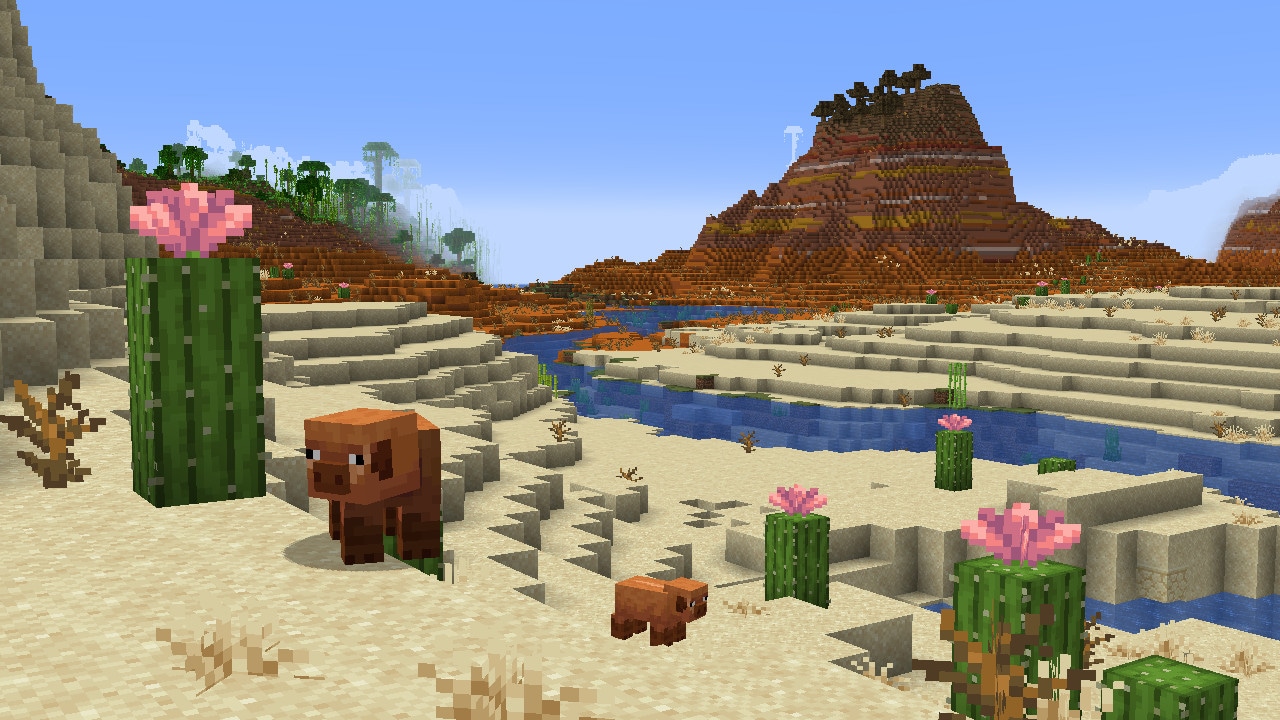
 is scattered on the ground, and in deserts flowers bloom on cacti
 .
Spawn eggs were redrawn. Mojang opened the game test system to map makers and data pack creators with the new /test command, and kept rebuilding the engine along the way. In Bedrock Edition the same drop came out in version 1.21.70.
Pigs, cows, chickens and sheep now live in the badlands, and all of them except sheep are warm there. A warm chicken lays brown eggs  , and warm chicks hatch from them. The cacti there grow flowers
 that make pink dye
 , and now and then the wind can be heard over sand and terracotta. This article describes the game as of 1.21.5, which received no hotfixes.
Warm and cold animals
Pigs, cows and chickens now come in three variants: temperate, cold and warm. The temperate ones are the familiar animals, and they spawn wherever the other two do not. The variant depends on the biome where the animal spawned, whether it appeared there naturally or was spawned by a player.
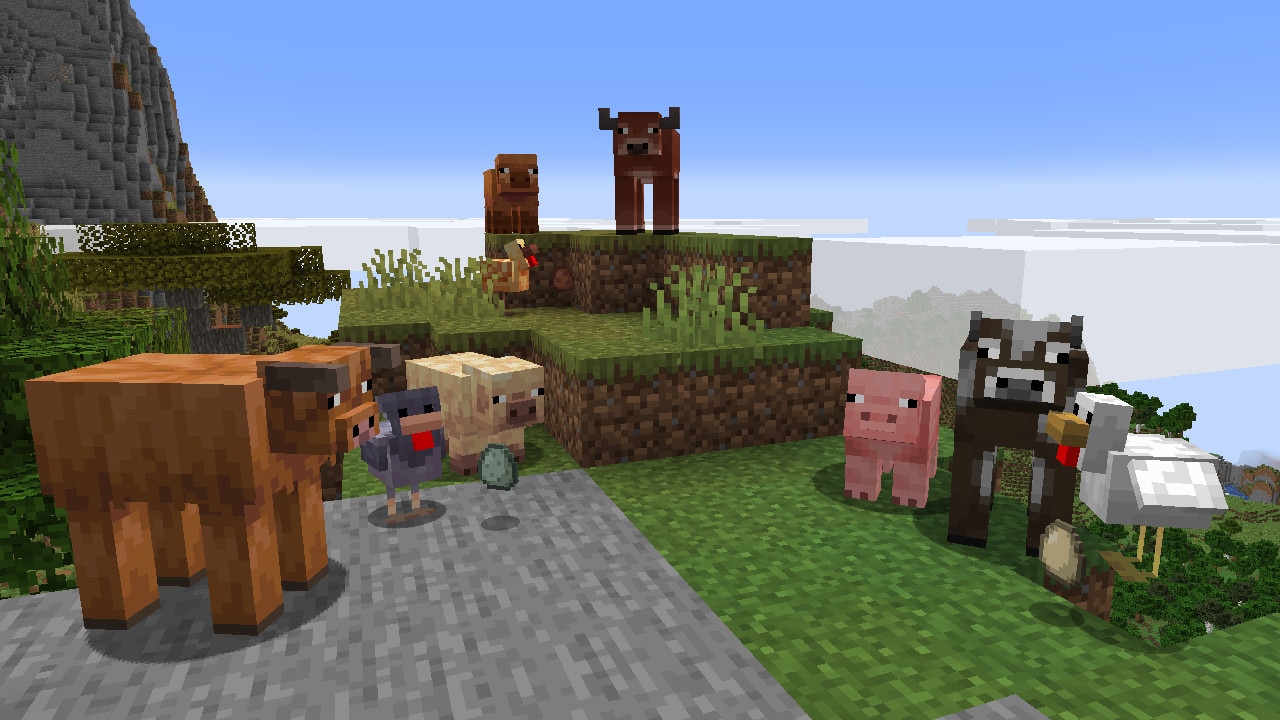
You will find cold animals in snowy biomes and on mountain peaks, in the grove, the taiga, the windswept forest and windswept hills, and also in frozen rivers and in cold and frozen oceans. Warm ones live in the desert, the badlands, savannas, jungles, the mangrove swamp and in warm and lukewarm oceans. The deep dark and all End biomes also count as cold, and all five Nether biomes count as warm, so a pig spawned from a spawn egg in the Nether will be warm. When a player breeds animals, the baby randomly gets the variant of one of its parents, and the biome has no effect on it.
Blue and brown eggs
A cold chicken lays blue eggs  , a warm one lays brown eggs, and the regular egg
 stays with the temperate chicken. Cold chicks hatch from blue eggs, warm chicks from brown eggs, and temperate chicks from regular eggs. All three kinds of eggs are grouped in the new
#eggs item tag.
Sheep
Sheep have no new variants, but their wool color depends on the biome where they spawned. In temperate biomes nothing changed: white sheep are the most common there, and black, gray, light gray and brown ones are less common. In cold biomes the most common color is black, and gray, light gray, white and brown sheep are less common. In warm biomes brown sheep spawn most often, and gray, light gray, white and black ones less often. A pink sheep is still rare, and there is a chance to meet one anywhere.
Where animals spawn and how they look
Pigs, cows, chickens and sheep now spawn in the badlands, and camels  in the desert. The temperate cow and both variants of the mooshroom
 have an extruded snout, and their legs are mirrored in the model. Dyeing a sheep also changes the color of its undercoat, as in Bedrock Edition, and the stark line at the back was removed from the wool texture. Sheep can now eat ferns
 , short dry grass and tall dry grass.
Wolf voices
A wolf's voice is a new trait that has nothing to do with its coat or its biome. Each wolf randomly gets one of seven voices when it spawns, and Mojang calls them personalities. The six new variants are called Big, Cute, Puglin, Angry, Grumpy and Sad, and the old wolf sounds became the seventh variant, called Classic.
Each voice has its own ambient, hurt, death, growl, whine and pant sounds. The unused howl sound was removed from the game. The subtitles that labeled wolf barking and whining as "Wolf pants" were fixed too.
New spawn eggs
Spawn eggs were redrawn to improve readability and accessibility. Each egg has its own design that captures the character of the mob, and the shape of the egg reflects the size of the mob in the world. Smaller mobs usually have smaller eggs.
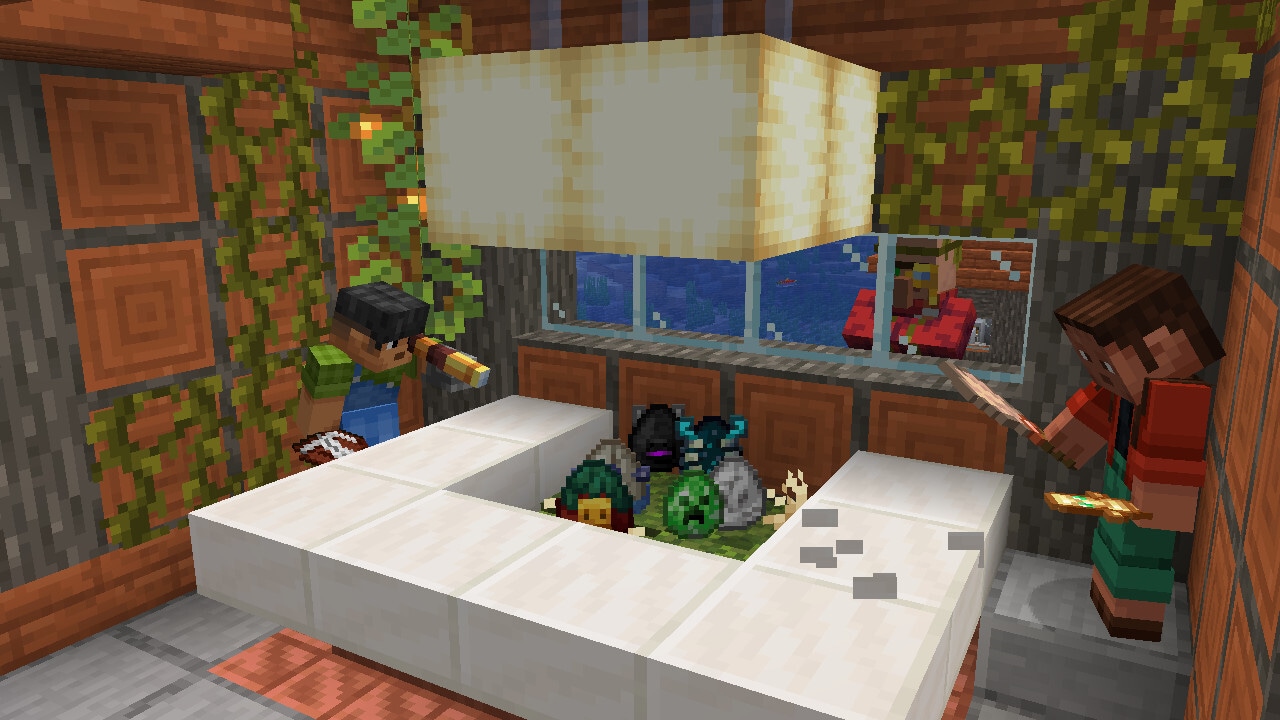
In the Programmer Art resource pack the eggs kept their old look. Spawn egg particles, which used the uncolored layer of the design, were also fixed.
Fallen trees
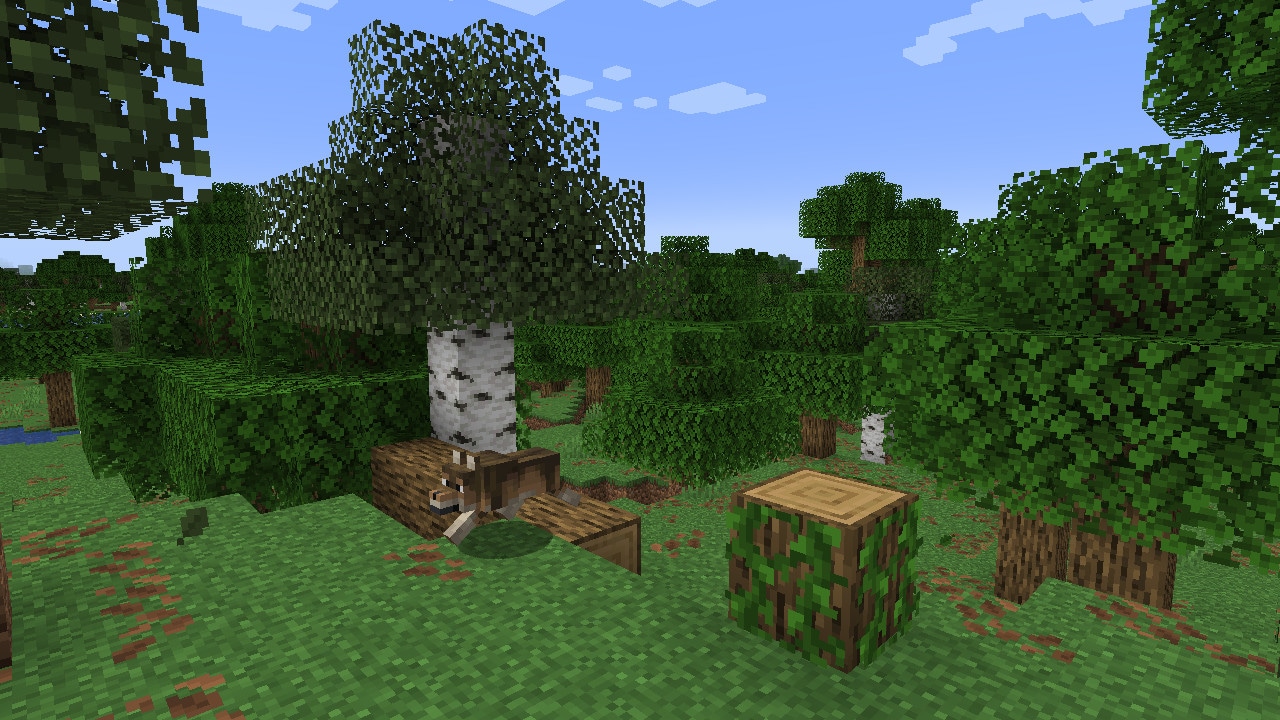
A fallen tree is a decorative variant of a tree whose trunk lies on the ground next to a stump. Bedrock Edition already had these trees, and they were added to Java Edition so that the versions do not differ. They come in oak, birch, spruce and jungle, and fallen birches come in a short and a long version. Some trunks are decorated with mushrooms or vines  .
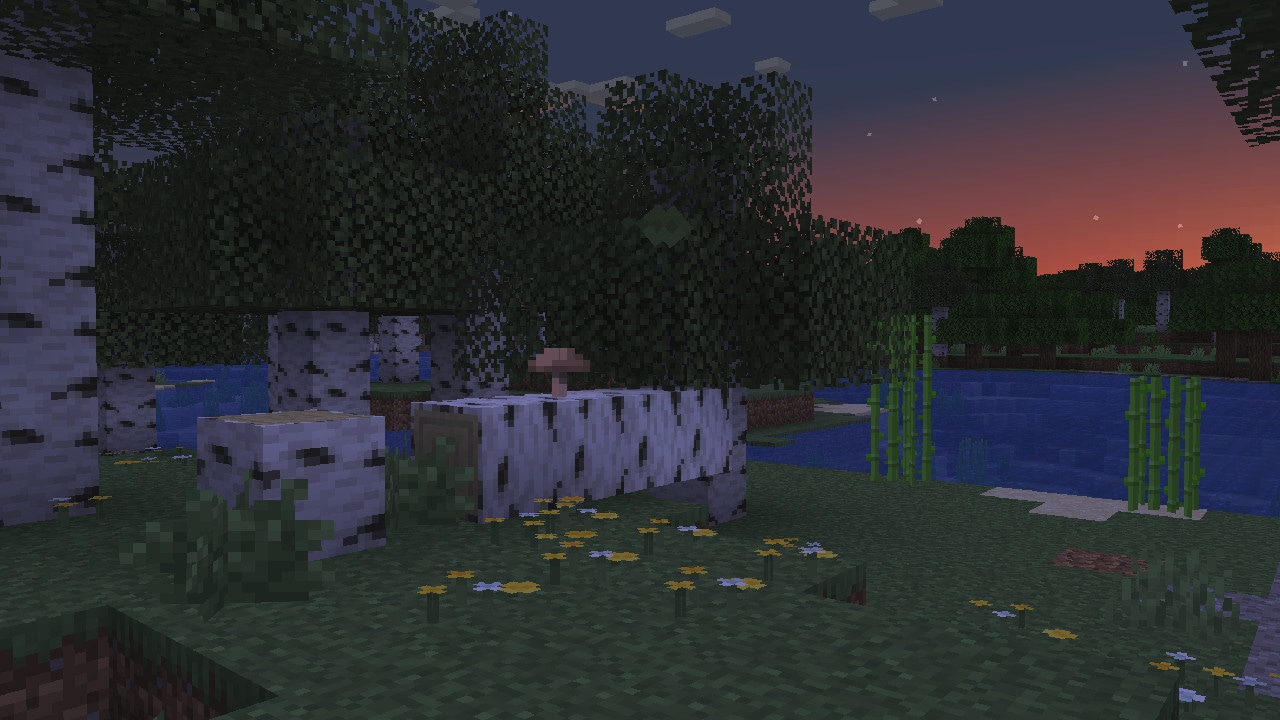
A fallen tree generates in all biomes where a standing tree of the same type grows. The exceptions are the bamboo jungle, the grove, the meadow and the river. The flower forest has fallen birches but not fallen oaks.
Firefly Bush
The firefly bush is a plant that grows next to water in swamps, mangrove swamps and near rivers, and in the badlands it turns up very rarely. The firefly bush emits a light level of 2, and when it gets dark, glowing firefly particles circle around it.
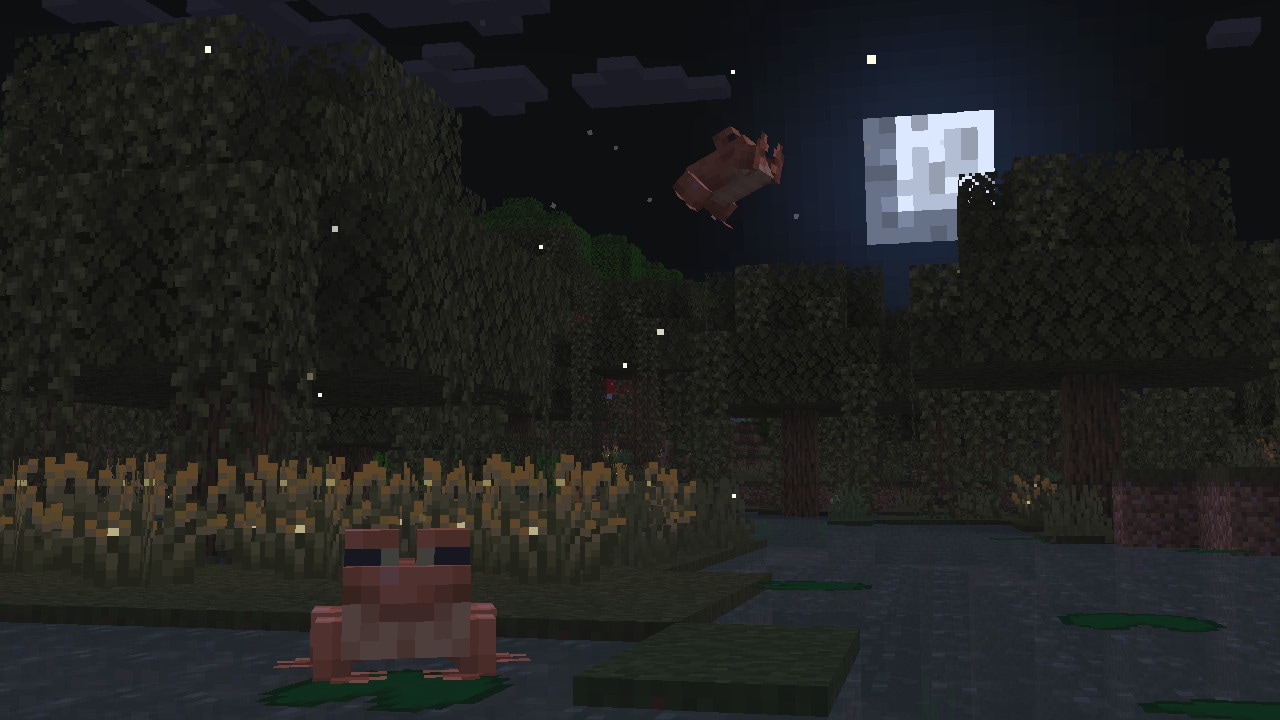
At night it sometimes plays sounds if it is not covered from above by a block that cannot be passed through. Leaves above it do not get in the way. Bone meal  grows a new firefly bush in a free adjacent space, if there is one.
Leaf Litter
Leaf litter is a decorative block of fallen leaves. This block lies on the ground in forests, dark forests and wooded badlands. Leaf litter only appears during world generation and does not regenerate during gameplay.
Up to four pieces of leaves fit in one block. Each new piece placed in the same block adds more leaves, and they can be turned in four directions. Leaf litter can be placed on any block with a full top face and replaced with another block when building.
You get it by smelting any leaves in a furnace. Leaf litter itself burns in a furnace as fuel, can go into a composter  , has its own sounds and is tinted to match the biome.
Falling leaf particles were added to all leaves that did not have them yet. These are oak, birch, mangrove, spruce, acacia, jungle, dark oak, azalea and flowering azalea leaves.
Wildflowers and Bush
Wildflowers  grow in birch forests, old growth birch forests and meadows. Up to four flowers fit in one block, they can be turned in four directions, and bone meal produces more of them. Wildflowers craft into yellow dye
 .
The bush  is a decorative block that grows in small patches in plains, forests, birch forests and old growth birch forests, windswept forests, windswept hills and windswept gravelly hills, and along rivers and frozen rivers. Bone meal grows another bush next to it. The bush itself only drops when broken with shears
 or a Silk Touch tool. It can go into a composter and be replaced with another block when building.
Dry Grass and Cactus Flower
Short dry grass  and tall dry grass
 grow in the desert and the badlands. Both are one block high, and this is how tall dry grass differs from regular tall grass, which takes up two blocks. Like the dead bush
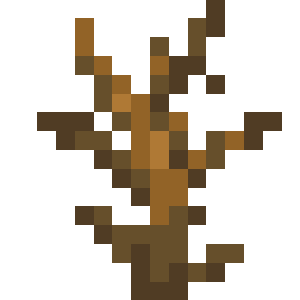 , they can be planted on sand, terracotta, dirt and farmland. Bone meal turns short dry grass into tall dry grass, and tall dry grass grows a new short one next to it. Both grasses go into a composter and into a furnace as fuel, and another block can be placed right in their spot.
Cactus flower
A cactus flower sometimes generates on cacti in the desert and the badlands. It can be placed on a cactus, on farmland or on any block that has center support on its top face. The flower can also grow on its own. When a cactus grows, there is a chance that a flower blooms on it instead of a new cactus block. On a cactus 1–2 blocks tall the flower blooms with a 10% chance, and on a cactus 3 blocks or taller, with a 25% chance. It only grows if all four sides around it are free. One flower makes one pink dye, and it can also go into a composter.
Desert sounds
Sand  , red sand
 and terracotta
 of any color sometimes play sounds on their own if blocks from the same group lie on at least three sides of them within 8 blocks. The quiet sand sound
block.sand.idle can play in any biome, and the wind sound block.sand.wind is only heard in the desert and the badlands. The dead bush also makes sounds if two blocks of terracotta, sand or red sand lie beneath it, and this works in any biome. Ambient block sounds in the desert, the badlands and the pale garden were moved in the sound settings from the "Blocks" category to the "Ambient/Environment" category.
Cartographer and Wandering Trader
The cartographer sells seven new maps, and each one leads to a village or other structure in its own biome. These are the desert, plains, savanna, snowy and taiga village maps, plus the swamp explorer map and the jungle explorer map. Cartographers from different village types sell different sets of maps and colored banners, and some prices and quantities changed.
The wandering trader  now has better prices and more trades, and keeps more stock of many items. It also buys basic supplies from players, so you can get emeralds even without buying anything from it. Each trader is willing to buy two items out of six. These are a water bottle, a water bucket
 , a milk bucket
 , a fermented spider eye
 , a baked potato
 and a hay bale
 . Starting with snapshot 25w08a, each such trade can be made twice before it locks.
The trader can now sell logs of eight types (acacia, birch, dark oak, jungle, oak, spruce, pale oak and cherry), an enchanted iron pickaxe  and a potion of invisibility. The old goods have not gone anywhere.
Other changes
Lodestone
The lodestone  is crafted from an iron ingot
 surrounded by eight chiseled stone bricks
 . According to Mojang, this makes it more accessible early in the game. Lodestones can be found in ruined portal loot in the Overworld and the Nether. The "Country Lode, Take Me Home" advancement moved from the "Nether" category to the "Adventure" category.
Creaking and creaking heart
The creaking  can be named with a name tag
 . A named creaking survives the day but still crumbles if it gets stuck with a player or wanders too far from its creaking heart
 . It still takes no damage of any kind and is linked to the creaking heart by particles. A creaking heart correctly placed between logs looks dormant during the day and spawns neither creakings nor resin at that time. The creaking heart waking up and falling dormant, as well as eyeblossoms
 opening and closing, depend only on the time of day: neither weather nor dimension brightness affects them anymore.
World and mobs
The pale garden takes up part of the space that used to go to the dark forest, and a woodland mansion can generate in the pale garden itself. Short grass grows slightly sparser in meadows. Bundles  turn up in some village chests. A zombified piglin
 drops experience and player-specific loot only if a player killed it. This brings it in line with the other mobs.
Simulation distance
All blocks within a player's simulation distance can receive random ticks. The same goes for chunks kept loaded by another source, such as an ender pearl  . Previously this only worked within 8 chunks of players. In a chunk loaded by a pearl or within the spawn chunks, crops grow, ice melts, snow falls and a cauldron
 fills with rain. Mob spawning, lava spreading fire and lightning strikes still happen only within 8 chunks of players. Fire with no player within 8 chunks of it does not burn or spread unless the
allowFireTicksAwayFromPlayer rule is turned on. Chunks loaded by a portal load again automatically when the world is reopened.
Sounds
The block of iron  , iron bars
 , iron trapdoor
 , iron door
 and heavy weighted pressure plate
 got new break, place, step, fall and hit sounds. The break sound of all blocks with the "grass" sound type became quieter. Blocks broken by a piston play their break sound.
Small changes
In leather boots  you can walk on powder snow, but after falling more than 2.5 blocks an entity falls through it. If the jump or fall was lower, it lands on top of the snow as before. A saddle
 dropped from a pig or a strider
 keeps its properties, such as a custom name. Bubble columns make less noise and fewer particles when entities they do not affect are inside them. Pale oak leaves and saplings got a different color on maps. When a world is uploaded to Realms, command blocks are enabled by default, and Hardcore single-player worlds can be uploaded too. The changelog also includes the line "Removed Herobrine".
Mojang reverted the fix for the bug where the player kept sprinting while performing actions that slow them down. According to the developers, the recent fixes did not quite hit the mark and caused too many negative side effects for parkour, speedbridging and movement in general. The developers want to revisit these mechanics later.
Graphics, interface and settings in Java Edition
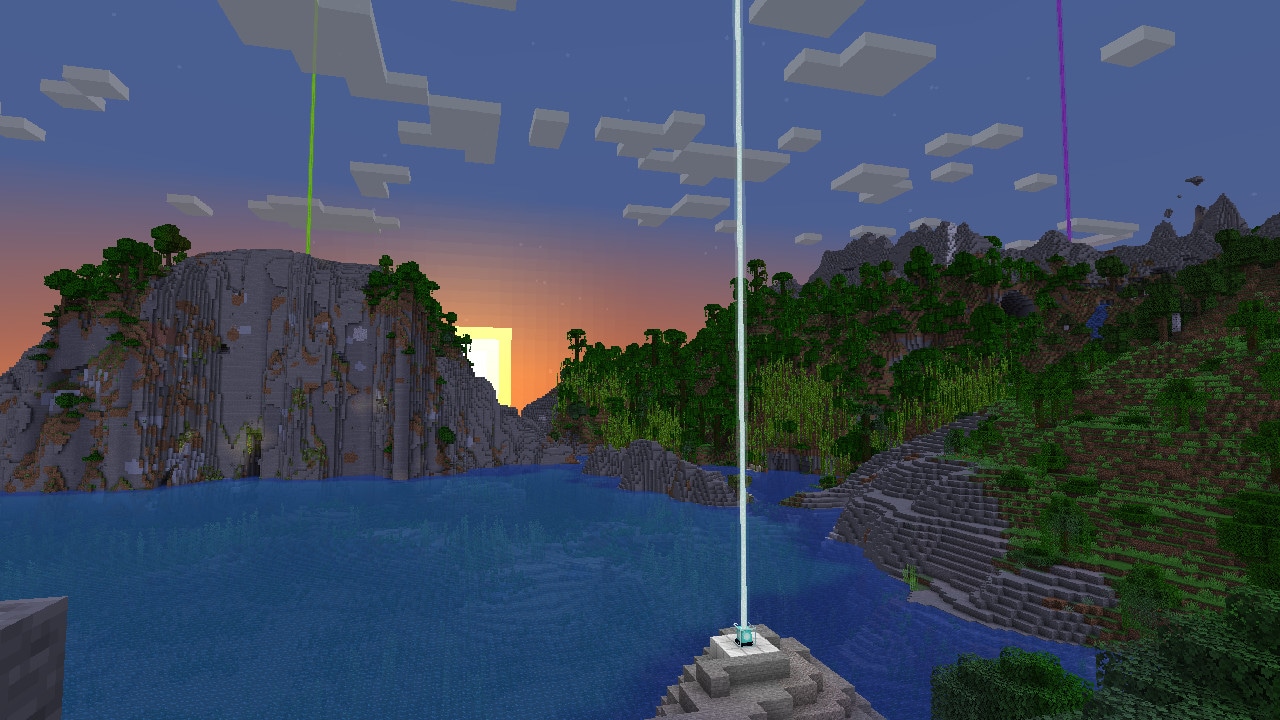
The beacon  and its beam are visible beyond 16 chunks, up to the render distance. To keep the beam from getting lost in the distance, it is drawn thicker the farther away you stand. The beam rises up to 2048 blocks high, twice the previous 1024.
The crossbow  shows all charged projectiles in its tooltip, not just the first, and includes the full tooltip of each one. Container items with contents, such as a chest
 picked with Ctrl and "Pick Block", list the first 4 items in their tooltip, just like shulker boxes
 . The narrator's volume follows the "Voice/Speech" slider. The main menu panorama was updated for the "Spring to Life" drop. If the previous launch of the game did not complete normally, the game resets the fullscreen option. Kyrgyz was added to the list of languages.
For resource packs
There are sprites for the new blocks and items, and each spawn egg got its own _spawn_egg sprite instead of the shared spawn_egg and spawn_egg_overlay. The creaking heart's active state was renamed to awake, and the creaking_heart_dormant and creaking_heart_top_dormant sprites were added for the dormant one. The old pig, cow and chicken textures became the temperate ones (temperate_pig, temperate_cow, temperate_chicken), and the cold and warm ones were placed next to them. The sheep_fur texture became sheep_wool, and the undercoat sits separately in sheep_wool_undercoat and is recolored in game. The enchanted_glint_entity.png file was renamed to enchanted_glint_armor.png, and a textures/colormap/dry_foliage.png colormap was added for leaf litter.
Saddles became equipment assets with the layers pig_saddle, strider_saddle, camel_saddle, horse_saddle, donkey_saddle, mule_saddle, skeleton_horse_saddle and zombie_horse_saddle. Their textures moved to entity/equipment//saddle.png, and for the camel and the horse family they were cut out of the main animal texture. Dyeable equipment layers are shown if the item has the dyed_color component, even when the item is not in the #dyeable tag.
Item models can now pick their look based on the contents of a component. The component property in select returns the value of a component, and the component condition checks it with a predicate written in the predicate and value fields. The paletted_permutations sprite source got a separator field (default _). An item on the ground hovers with the size of its model taken into account and does not sink into the block beneath it. A stack whose model is deeper than 1/16 of a block is drawn scattered around the center, and a thinner one as a flat pile.
The JSON definitions of core shader programs and post-processing effects were removed, although the shaders themselves can still be overridden. In post-processing effects the program field was replaced by vertex_shader and fragment_shader, every uniform needs a type field, and the game fills in "global" uniforms such as ModelViewMat, ProjMat, GameTime or FogColor on its own in any shader. Mojang reminds that overriding core shaders is not officially supported, and the shaders themselves may change at any time. Eventually Mojang would like to offer a supported replacement. For developers, the client got a --renderDebugLabels argument that labels OpenGL objects.
Game rules
The "Allow TNT to be activated and to explode" rule (tntExplodes, default true) came from Bedrock Edition. If you turn it off, TNT does not explode and cannot be lit. The "Tick fire away from players" rule (allowFireTicksAwayFromPlayer, default false) lets fire and lava spread flames farther than 8 chunks from a player. The fire and lava blocks themselves still have to be within simulation distance.
For servers, data packs and map makers
The data pack format reached version 71, and the resource pack format reached 55. During development the changes came in versions 62–71 and 47–55.
Game tests
The game test system is a built-in way to check how the game works. A test consists of a definition in the test_instance registry and a saved structure with the initial setup. The definition specifies the environment (environment), the structure (structure) and the maximum number of ticks (max_ticks). Optional fields set a delay before the start (setup_ticks), whether the test is required (required), the rotation (rotation), manual-only runs (manual_only), open sky (sky_access) and the number of attempts (max_attempts and required_successes). A block-based test (block_based) works through test blocks  in the "Start", "Log", "Fail" and "Accept" modes, and the structure needs at least one Start block and one Accept block. A function test (
function) calls a function from the test_function registry, which is added by a mod.
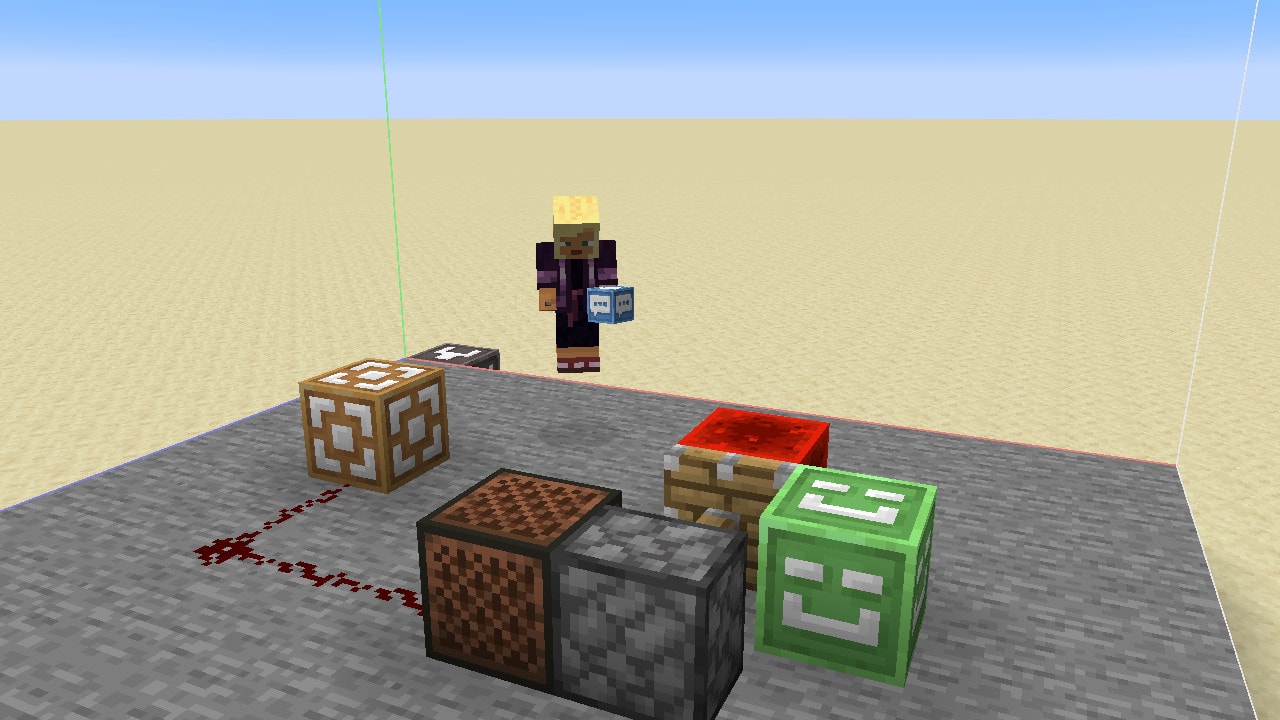
Environments from the test_environment registry prepare the conditions for a group of tests. They come in the types all_of, function (setup and teardown functions), game_rules, weather and time_of_day, and by default the game has one empty environment, minecraft:default.
The /test command creates, locates, runs, verifies and resets tests through the clear, create, locate, reset, pos, run, stop and verify subcommands. Several tests are laid out in a grid and run in parallel, but no more than a certain number at a time, and the rest start in later batches. A beacon beam stands over each test. A gray beam means the test is running, red means a required test failed, orange means an optional one failed, and green means success. The error is written into a book on a lectern and shown on screen. Tests are designed for a superflat world. The terrain around a test is replaced with stone when it starts, and the test itself is surrounded by barriers. Each test in the world is controlled by a test instance block  .
The server jar has a net.minecraft.gametest.Main entry point. It starts a server, runs all tests and shuts down. The --packs, --tests and --universe (default gametestserver) options set the data packs, the test selection and the world folder, --report saves a report in JUnit XML format, and --verify runs each test 100 times for each 90° rotation.
Commands
The /setblock, /fill, /clone and /place template commands got a strict mode, in which blocks are placed as is, without block and shape updates. The structure block  in "Load" mode got a similar "Strict Placement" setting.
/setblock and /fill handle block entity data more carefully. If the command specifies no data but the block has some, the data is kept. To clear it, you have to specify {} explicitly. The command counts as successful if the block state or its data changed. The replace option in /fill no longer has to come last, and strict, destroy, hollow or outline can follow it. The horse.saddle slot became saddle and works for any entity that can wear a saddle.
SNBT and NBT
SNBT, the text notation for data in commands, became more flexible. Lists can be heterogeneous, meaning they can hold elements of different types, and /data works with them like with regular ones. The NBT file format did not change, and such lists are turned into wrappers like [{'':'a'},{'b':3}] when saved. Numbers can be written in hexadecimal (0x) and binary (0b) form, with an exponent (1.2e3), with underscores (0xAB_CD) and with signed or unsigned suffixes (240ub and -16sb are the same number). Integers other than zero cannot start with 0, and unquoted strings cannot start with a digit, a dot, a plus or a minus. Quoted strings support escape sequences like \n and \N{Snowman}, lists and compound tags allow one trailing comma, and the bool(arg) and uuid(str) operations were added for macros. In Pre-release 1, command arguments got back the ability to accept numbers instead of booleans, but Mojang warns that this is temporary.
Text components
Text components are no longer stored as JSON inside a string and are embedded in the data directly. For example, minecraft:custom_name="{"text":"Renamed item"}" becomes minecraft:custom_name={text:'Renamed item'}, and in /tellraw, /title and other commands components are written in SNBT. NBT has no separate boolean type, so boolean translation arguments are passed as strings. Components in /bossbar, /scoreboard and /team are resolved before use in the context of the @s entity.
Hover and click events changed their fields. hoverEvent became hover_event, and clickEvent became click_event. In show_text the contents field became value, and in show_item and show_entity the contents were moved to the top level. In show_entity the id field became uuid, and type became id. The open_url action takes the address from url and accepts only the http:// and https:// schemes. run_command and suggest_command take the command from command, and in run_command a leading slash is no longer required. change_page takes the number from page, and it must be a positive integer.
Entity data
Custom data, which used to exist only on the marker, is now available on all entities. It is the minecraft:custom_data component, which is stored in the data field if it is not empty, is set by the spawning item and is checked by predicates. The equipment of mobs and armor stands is stored in a single equipment field with the slots head, chest, legs, feet, mainhand, offhand, body and saddle instead of ArmorItems, HandItems and body_armor_item. The player's armor and offhand go there too. Drop chances are gathered in drop_chances (default 0.085). The saddle became the saddle slot, which replaced SaddleItem on the horse family and the Saddle flag on pigs and striders, and whether it drops on death also depends on drop_chances.
The FallDistance field became fall_distance of type double, the sleeping coordinates are gathered in sleeping_pos, and the player's respawn point in a respawn object with the pos, angle, dimension and forced fields. Coordinates were merged in a similar way for the turtle, the vex, the phantom, item frames, paintings and leash knots. Many fields got default values. For example, the Duration field of an area effect cloud defaults to −1, and such a cloud never disappears. The potion entity was split into splash_potion and lingering_potion, and a cloud from a lingering potion gets the potion_duration_scale field with a value of 0.25. The owner of a tamed animal does not have to be a player.
Item components
The weapon component increases the item's use statistic with each attack and takes off durability (item_damage_per_attack, default 1), and its disable_blocking_for_seconds field disables the opponent's shield for the given time. The blocks_attacks component lets an item block attacks like a shield. It sets the delay before blocking (block_delay_seconds), the disable time multiplier (disable_cooldown_scale), the damage reduction damage_reductions with the angle horizontal_blocking_angle (default 90°), the damage to the item itself item_damage, the damage types that bypass blocking (bypassed_by), and the sounds block_sound and disabled_sound. The new potion_duration_scale, break_sound, provides_banner_patterns and provides_trim_material components set the potion effect duration multiplier, the break sound, the pattern for the loom and the trim material. The tool component got a can_destroy_blocks_in_creative field. The equippable component works with the saddle slot and lets any mob be equipped in the body slot if allowed_entities allows it, and its equip_on_interact field lets you put the item on a mob with a right click.
A single tooltip_display component with the hide_tooltip and hidden_components fields controls tooltips. It replaced the show_in_tooltip fields and the hide_additional_tooltip and hide_tooltip components. The attribute_modifiers, dyed_color, can_place_on, can_break, enchantments and stored_enchantments components are always written in simplified form, for example enchantments={sharpness:2} or dyed_color=12345. The toggle_tooltips loot function toggles any component in tooltip_display.
Entity components and predicates
Entity variants and appearance are set by components, for example wolf/variant, wolf/sound_variant, wolf/collar, cat/variant, sheep/color, villager/variant or tropical_fish/pattern. If a spawning item has such a component, it carries over to the entity, just like custom_name. Spawning items include spawn eggs, mob buckets, arrows, lingering potions, armor stands, paintings, item frames, minecarts and boats. Entity predicates got the components and predicates fields, and variant sub-predicates like minecraft:cat, minecraft:wolf or minecraft:villager were removed. Block predicates got the same fields, where they check block entity components.
Mob variants
Pig, cow, chicken, cat and frog variants are defined in the pig_variant, cow_variant, chicken_variant, cat_variant and frog_variant folders, and wolf voices in wolf_sound_variant. For pig, cow, chicken, cat and frog variants Mojang calls this feature experimental. A variant file specifies the texture asset_id and the spawn conditions spawn_conditions, and for pigs, cows and chickens also the model model. Spawn conditions work the same way everywhere they exist. Each entry contains a priority priority and an optional condition condition of the type minecraft:biome, minecraft:moon_brightness or minecraft:structures. Of the matching entries, the ones with the highest priority remain, and the game picks one of them at random. For wolf variants the textures are gathered in the assets field with the keys angry, tame and wild, and the cat variant tags #default_spawns and #full_moon_spawns were removed.
Recipes, world generation and tags
The result of a crafting_transmute recipe can set a count and a set of components. smithing_transform requires a base, smithing_trim requires a base, a template and an addition, and the new pattern field sets the trim pattern. The item field was removed from the trim pattern and trim material registries. The new fallen_tree feature type places a stump and logs next to it (log_length from 0 to 16), and the attached_to_logs decorator attaches other blocks to the logs. Biome effects got a dry_foliage_color field for tinting leaf litter. In advancements, the background field is written without the textures/ prefix and the .png extension. The firefly and tinted_leaves particles were added.
New tags include #sword_instantly_mines, #edible_for_sheep, #book_cloning_target, #can_equip_saddle, #spawns_cold_variant_farm_animals, #spawns_warm_variant_farm_animals and seven structure tags for cartographer maps. There is also a #flowers item tag to pair with the block tag of the same name, and #dead_bush_may_place_on was renamed to #dry_vegetation_may_place_on.
Networking
The player_chat packet contains a message counter that starts at 0 on login and goes up by 1 with each message. If the counter changes unexpectedly, the client disconnects, so missed or reordered messages are noticed faster. The chat and chat_command_signed packets carry a checksum byte for the signatures of the last seen messages, and a value of 0 disables the check. It helps notice faster when the list of those messages goes out of sync.
How development went
Over 11 weeks, 1.21.5 got ten snapshots, three pre-releases and two release candidates.
- Snapshot 25w02a, January 8, 2025. The first 1.21.5 snapshot brought warm and cold pigs, wildflowers, leaf litter and falling leaf particles for all leaves. The lodestone became craftable from an iron ingot, iron blocks got new sounds, and the creaking could now be named with a name tag. Text components stopped being stored as JSON inside a string. Data packs got version 62, resource packs 47.
- Snapshot 25w03a, January 15. Game tests became available to data packs along with the
/testcommand, test blocks and a separate server entry point. Leaf litter could now be put into a composter. Format versions rose to 63 and 48. - Snapshot 25w04a, January 22. Two movement fixes were reverted. One concerned sprinting during actions that slow you down, the other diagonal movement while sneaking or using some items. Kyrgyz, the crossbow tooltip with all projectiles and the
blocks_attacksandtooltip_displaycomponents were added, and SNBT learned heterogeneous lists. Format versions became 64 and 49. - Snapshot 25w05a, January 29. Warm and cold cows, the firefly bush, the bush and desert sounds appeared in this snapshot. Beacon beams became visible from far away, and the temperate cow got an extruded snout. Data packs got version 65, resource packs 50.
- Snapshot 25w06a, February 5. Warm and cold chickens arrived with blue and brown eggs, along with dry grass and the cactus flower. Random ticks were extended to the whole simulation distance, and the
allowFireTicksAwayFromPlayerrule was added for fire away from players. Firework and crossbow tooltips started showing identical stars and projectiles in short form. Format versions rose to 66 and 51. - Snapshot 25w07a, February 13. Sheep got wool colors by biome, and at first cold biomes had light blue, blue and cyan sheep, while warm biomes had yellow, orange and red ones. The cartographer and wandering trader trades were updated, camels started spawning in the desert, and bundles in village chests. Many fields in entity data were renamed and merged. Format versions became 67 and 52.
- Snapshot 25w08a, February 19. Spawn eggs got their new look, wolf voices appeared, and the unusual sheep colors from the previous snapshot were removed. Leaf litter started being tinted by biome, sheep learned to eat ferns, and the undercoat started being recolored together with the wool. Trades in which the wandering trader buys from the player could now be made twice. Data packs got version 68, resource packs 53.
- Snapshot 25w09a, February 26. Fallen trees appeared in Java Edition, and the firefly bush started growing in mangrove swamps and, very rarely, in the badlands. The SNBT syntax was expanded considerably. Data packs got version 69.
- Snapshot 25w09b, February 27. The second snapshot of the week came out because of frequent problems in the previous one. It fixed crashes, for example when rendering the guardian and the breeze, as well as menus that had no text before entering a world.
- Snapshot 25w10a, March 5. The
tntExplodesrule, custom data on all entities and a new menu panorama appeared. The cactus flower could now be placed on farmland, and blocks broken by a piston started making sounds. Format versions rose to 70 and 54. - Pre-release 1, March 11. From this version on, the changes were mostly bug fixes. The Programmer Art pack got the old spawn egg textures, resource packs got version 55, and command arguments again accepted numbers instead of booleans. Among the fixes were excessive video memory use and the
tntExplodesrule not stopping TNT minecarts. - Pre-release 2, March 12. The data pack version became 71, because the bump had been missed in the first pre-release. Crashes were fixed, as was the main menu, which broke with the Mesa 25.0 driver.
- Pre-release 3, March 18. Several recently introduced bugs were fixed. Among them were the missing outline of the debug crosshair on the F3 screen and experience orbs that followed players in spectator mode.
- Release Candidate 1, March 20. Mojang called it the version it plans to release unless new critical bugs turn up. Magma lighting and beacon shading were fixed.
- Release Candidate 2, March 24. Terrain blending was turned on in new chunks, and moving pistons now pass block effects on to entities. The release was set for the next day.
- Release 1.21.5, March 25, 2025.
Bug fixes
The 1.21.5 changelog lists 132 fixed bugs. A noticeable share concerns saddles, bubble columns, End portals and small inaccuracies in player movement.
Saddles and mounts
Saddles apply attribute modifiers and can be replaced without taking them off first, and a horse can no longer wear several saddles at once. The saddle is visible on invisible camels and horses and no longer stays visible during the death animation. The sound of putting a saddle on a horse, donkey, mule or camel plays even if the animal was just summoned. Unused pixels and the chest bag drawing were removed from horse textures.
Bubble columns, arrows and boats
A bubble column no longer has the opposite effect on wind charges, affects shulker bullets again and behaves the same at the surface no matter what lies nearby. Boats do not sink because of string on the water surface, do not fly up on string over rising bubble columns and do not rock endlessly in a one-block-high downward column. Arrows and tridents catch fire when flying through lava, and burning ones go out in water placed at their location and in rain if they are stuck in the ground. In flowing lava they no longer move after hitting a block.
Movement and falling
While flying with elytra, the player can grab onto a climbable block and switch to swimming in water. When sprinting at certain angles, the player is no longer pushed to the left or right, slow movement does not pull them toward cardinal directions, and sneaking on ice does not snap the direction to the axes. A rounding error in fall damage was fixed, and a separate sound plays again when falling from a great height. Powder snow again slows down a player falling from a height, and on its edge you can no longer get stuck or take fall damage in leather boots.
Portals, the End and fog
The exit portal in the End no longer generates at the highest block above 0 0 and is no longer left incomplete, and shulker boxes and other blocks inside it drop as items when the portal changes state. End portals do not delete blocks inside them, and a blocked portal does not let through even a very fast-moving player. End portals and End gateways fade away in render distance fog and in water, lava and powder snow fog, and look correct with Blindness and Darkness. The End crystal beam is no longer black, and a Nether portal does not teleport a player standing a full block away from it.
Sounds and subtitles
The player blocking with a shield now hears the blocking sound too, and the attacker hears the shield breaking sound. The narrator does not speak at full volume when the sound is off, HRTF audio turns off together with directional audio, and granting all advancements at once is no longer deafening. The subtitles for a shulker box opening and closing no longer say "Shulker", and a settings button does not click twice if a slider ends up under the cursor on the next screen.
Mobs
Angry zombified piglins drop experience and rare loot only if a player killed them, and reinforcements are not angry at the player if they killed the caller in one hit. Mobs from spawners and from the /summon command drop their equipment, and piglins from /summon pick up gold. Mobs that accidentally fall into water do not lose their path, tamed wolves stop being angry at creakings that have despawned, and sculk sensors detect a hit on a naturally spawned stationary creaking. Baby polar bears are no longer too small, and sheep heads no longer stutter when they look up or down.
Commands and data
The /data remove command can now remove villager gossips, the beam target of an End crystal, block loot tables and the CustomName of block entities. /setblock and /fill no longer clear the inventory of a block entity they place again. /fill places adjacent directional blocks correctly, and /setblock can place waterlogged states of glow lichen, resin clumps and similar blocks. Tamed animals can be added to a team with /team, and /teleport does not limit camera pitch to ±90 degrees from the original.
Interface and graphics
The game no longer uses several times more video memory than needed after exploring the world for a long time, and it no longer resaves all maps on every autosave. The attribute modifier tooltip for the chest slot no longer calls it the body, and the notification about one unlocked recipe does not talk about several. The crossbow loading animation does not stop while the button is held, and the F11 key updates the fullscreen setting. A double resin brick slab drops two slabs when broken, and weeping and twisting vines no longer disconnect.
Bedrock Edition 1.21.70
Bedrock Edition 1.21.70 came out on March 25, 2025, the same day as Java Edition 1.21.5, and brought the same "Spring to Life" drop. The plants, animal variants, wolf voices, new spawn eggs and the cartographer and wandering trader trades are the same, and the Bedrock changelog lists changes that were not in Java Edition 1.21.5.
- Bedrock single-player got a pause, which Java Edition has had for a long time. You can pause the game if you are alone in your own local world. When someone joins, the game resumes and shows a notification. Pausing does not work on Realms, on servers or when playing with a friend on your local server. The feature was rolled out gradually and was supposed to become available to everyone after two weeks.
- In swamps firefly bushes grow anywhere, and near water they are twice as common.
- The wandering trader also sells mangrove logs.
- "Keep Inventory" counts as a cheat again on all difficulty levels.
- Achievements can now also be earned in worlds with add-ons.
The next Java version is 1.21.6.
Download JustLauncher
Discussion
No comments yet
Be the first to leave one