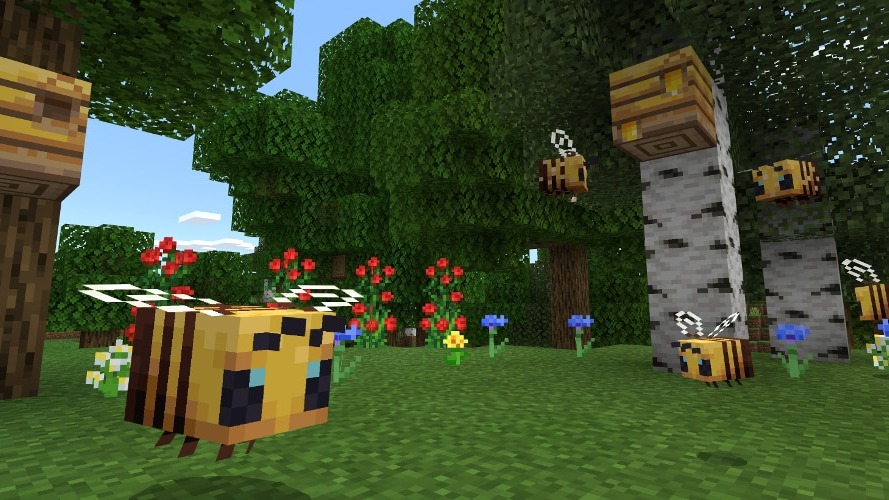
Minecraft 1.15 "Buzzy Bees" Update
Bees, honey and honeycomb arrive in Minecraft, along with a big bug cleanup and a small speed boost.
 English
"Buzzy Bees" was the last Minecraft update of 2019, and it was built entirely around a single creature. It came out on December 10, 2019, in Java Edition 1.15, and Bedrock got its own version, numbered 1.14.0, the same day. The heart of it is bees, their homes, honey and honeycomb. Everything else is a set of fixes and a few performance improvements, so the update is small in terms of new content.
Mojang themselves called this work an update about "bees and bugs" and promised fewer errors and more frames by the end of the year. Two more small versions followed the main release. Java Edition 1.15.1 arrived on December 17, 2019, and 1.15.2 on January 17, 2020. That one was the last in the 1.15 branch. This article describes the game as of 1.15.2.
Bees
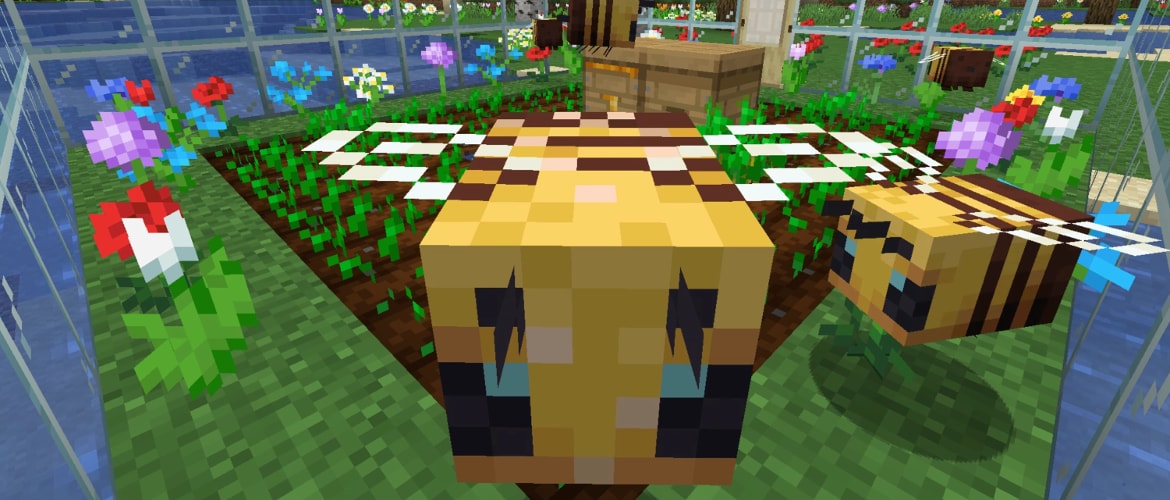
Bees  are fluffy, friendly creatures that live near their home and spend their whole lives gathering pollen from flowers. They are neutral and never attack first, so do not hit them without reason and do not destroy their nest. A Bee has 10 health, or five hearts. Bees are arthropods, but unlike Spiders and Silverfish they spawn at any difficulty, even Peaceful, and you can find them wherever a Bee Nest has grown on trees nearby.
Where bees live
Bees do not appear on their own in an open field. They spawn together with Bee Nests, which generate on trees. Each such nest holds two or three bees. During the day they scatter around the area for pollen, and by night and in the rain they come back home.
Breeding
Give two adult bees a flower each and they enter love mode, a baby appears, and you get 1–7 experience. In 1.15 any flower works for this, including the Wither Rose. The baby grows into an adult bee in about 20 minutes, that is, one in-game day, and you can shorten that time by feeding it a flower. Each feeding cuts the remaining time by 10%. After breeding, the parents need a 5-minute break. While a bee is working inside its home, the growth timer and the countdown to the next breeding both stop.
Pollination and crop growth
To collect nectar, a bee circles over a flower for more than 400 ticks, that is, about 20 seconds. If you hit it during that time, it drops what it was doing. Carrying a load of pollen, it flies home, dropping nectar particles along the way. If such a bee flies one or two blocks directly above a growing crop and has a home, the plant advances one growth stage, as with Bone Meal. With a single load of pollen a bee can fertilize up to ten plants. The chance of pollination per tick is about 5%, and the whole round trip takes about two minutes. In 1.15 bees pollinate wheat, potatoes, carrots, beetroots, melon and pumpkin stems, and the sweet berry bush.
Anger and the stinger
Bees get angry if you hit one of them, collect honey or honeycomb without a Campfire nearby, or destroy a nest. Both the bee you touched and all the nearby ones get angry. Their eyes turn red and they swarm the offender. Bees sting only once. Like Llamas, they are limited to a single attack. The anger lasts from 20 to 39 seconds, and the exact time is chosen at random. A sting applies Poison for 10 seconds, after which the bee that stung loses its stinger, can no longer attack, does not hide at home even at night, and dies in 50–60 seconds. On the player the stinger shows as a small black dot, and the new death message reads "was stung to death". On Peaceful difficulty bees deal no damage and stay harmless.
Night, rain and water
At night and during rain bees go home, and rain anywhere in the world drives them into shelter, even if it is dry right above the bee. Inside they wait at least two minutes before flying out again. In the Nether and the End, where there is no day cycle and no weather, bees work without rest. They try to fly around water, and if they do linger in it for more than a second, they start losing one health every half second.
Bee Nests and Beehives
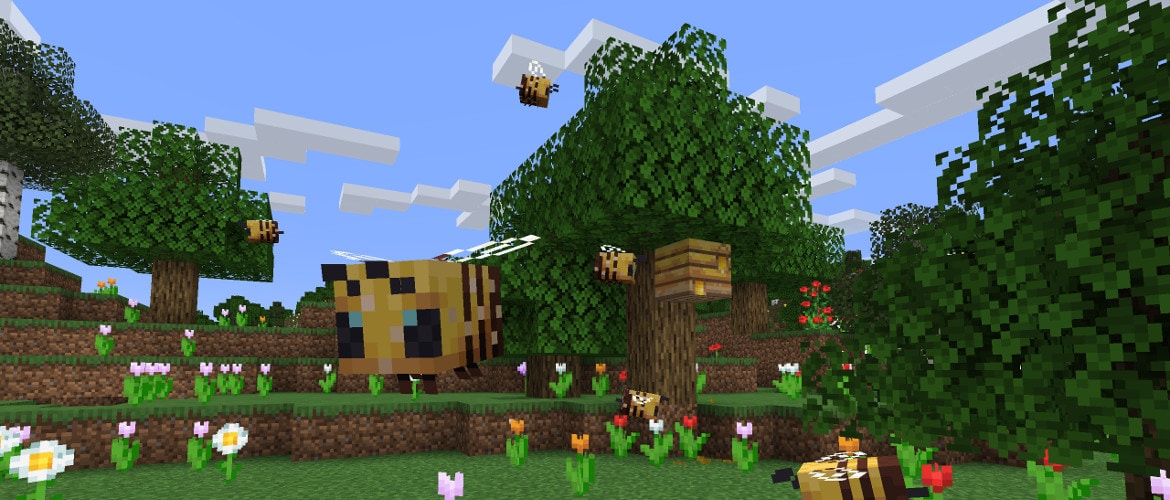
The Bee Nest  and the Beehive
  are two nearly identical blocks where bees live. The nest appears in the world on its own, while you build the hive by hand. Bees treat the nest and the hive the same way. Each home holds up to three bees, and honey slowly builds up inside. Look for a nest on birches and oaks on plains.
Where nests appear
In 1.15 nests appear only on naturally generated oaks and birches. At the launch of the update you could find them in the flower forest, on plains and sunflower plains. In 1.15.2 nests started to appear with a 0.2% chance in the regular forest and its birch variants. At the same time nests became renewable. An oak or birch sapling that grows within two blocks of a flower on the same level turns into a tree with a nest and two or three bees with a 5% chance.
How to make a hive
The hive is crafted at a Crafting Table from six Planks 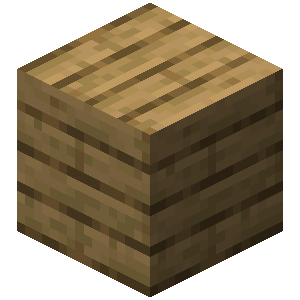 and three Honeycomb
  . The planks go in the top and bottom rows and the honeycomb in the middle (the PPP/HHH/PPP pattern). Any planks available in the game at that point will do.
Honey level
The nest and the hive have a honey level from 0 to 5. Each bee that comes home after a successful trip raises it by one, and with a 1% chance by two at once. You can harvest only at level five, after which the counter resets to zero.
Harvesting honeycomb and honey
Point Shears  at a nest or hive at honey level five and you get three honeycomb. An empty Glass Bottle
  gives one Honey Bottle. Both work only at honey level five.
A campfire saves you from stings
If you harvest without protection, the bees inside the home get angry. Place a Campfire  within five blocks directly under the nest or hive and the smoke calms the bees, so you can harvest in peace. Just remember that open fire can set the nest itself and the flowers around it alight.
How to move a nest
A nest drops only when mined with a tool enchanted with Silk Touch. The bees and the honey supply are kept in that case. Without the enchantment the nest does not drop at all, and the disturbed bees fly out in a rage. A hive always drops as a block, but again only Silk Touch keeps its residents and honey supply. Bees fly into the home from any side but leave strictly through the front. In 1.15.2 a bug was fixed. Breaking a neighboring nest or hive with Silk Touch no longer angers the bees.
Honey and Honeycomb
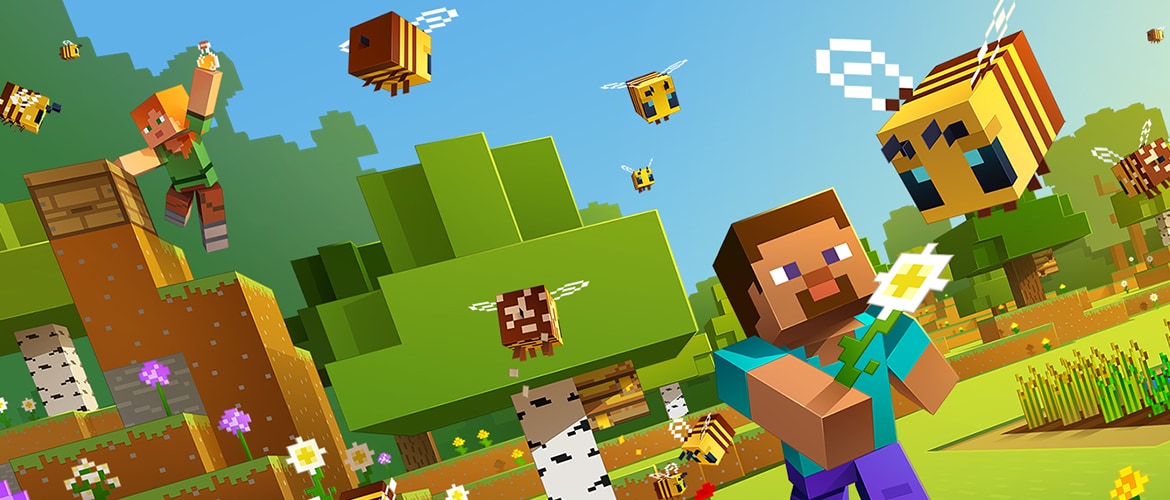
The two products of bees, sticky honey and honeycomb, can be obtained from a nest or hive filled with honey. Honey is used as food and to make the sticky Honey Block, while honeycomb goes into hives and decorations. Let's go through each item in turn.
Honey Bottle 
- Restores 6 hunger and gives 1.2 saturation.
- Drinking it removes Poison, but unlike milk it leaves other effects in place.
- Drinking takes 2 seconds, a quarter longer than eating normal food. Drinking honey has its own sound. You can drink it even with a full hunger bar.
- Stacks up to 16.
- A Dispenser with empty bottles can fill it without angering the bees.
- One bottle yields 3 Sugar
 .
.
Honey Block 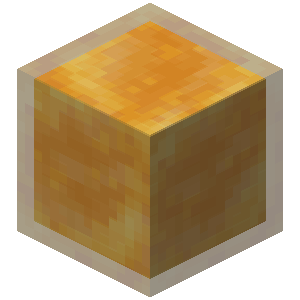
- Crafted from four Honey Bottles in a 2×2 pattern. By the reverse recipe one Honey Block and four empty bottles give four Honey Bottles.
- You walk across the block about 60% slower than normal, and you cannot run on it at all.
- From a Honey Block you can jump only 3/16 of a block.
- Falling onto a Honey Block cuts the damage by about 80%.
- You can slowly slide down a wall of these blocks and take no fall damage at all.
- A Piston drags a Honey Block along with neighboring blocks in the same direction, and anyone standing on top is not thrown off but moved along with the Honey Block.
- A Honey Block and a Slime Block do not stick to each other, and this property is used in many redstone contraptions with pistons.
Honeycomb
- Drops three at a time when sheared from a full nest or hive.
- In 1.15 it is used to make hives and Honeycomb Blocks.
Honeycomb Block 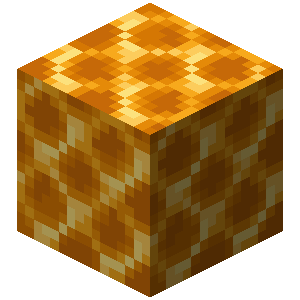
- Crafted from four honeycomb and serves only for decoration.
- It cannot be broken back down into honeycomb.
Other changes in the game
The update did not stop at bees. New advancements, several small features from Bedrock, a new command and game rules were added to the game.
Dispenser 
The Dispenser learned to work with hives and bottles. With shears it cuts honeycomb from a nest or hive at honey level five, with bottles it collects honey, and by water it fills them with water. It now correctly ejects empty bottles when there is no water in front of it.
New advancements
- "Sticky Situation" — jump into a Honey Block to slow your fall.
- "Bee Our Guest" — place a Campfire under a hive and collect honey without angering the bees.
- "Total Beelocation" — use Silk Touch to move a Bee Nest with three bees inside.
Iron Golem
A heavily damaged Iron Golem cracks, and now you can patch it up with Iron Ingots  . How visible the cracks are depends on how much health the golem has left relative to its full total.
Bell 
The Bell now rings when you send it a redstone signal.
Features from other editions
Some of the small things familiar from Bedrock made their way into Java Edition.
- Sleeping in a bed during the day sets your respawn point, and a message appears when it is set.
- The
doInsomniarule can be turned off so that phantoms stop appearing at night. - The
doImmediateRespawnrule enables immediate respawn without the death screen. - The
drowningDamage,fallDamageandfireDamagerules turn off damage from water, falling and fire. - Sponges dry out when placed in the Nether.
- A firework flies in the direction the Dispenser launches it.
- A boat used as fuel smelts 6 items in a furnace.
- A Campfire can be put out with a shovel.
- Groups of spawning animals sometimes already include babies.
- A parrot sits on the player's shoulder even while the player is riding.
- The composter is now crafted from wooden slabs.
- In Creative mode you can eat any food.
- Dark prismarine is crafted with black dye.
- Scaffolding burns longer as fuel.
- Counters for interactions with the anvil and the grindstone were added.
The /spectate command
The new /spectate command switches the camera to a chosen target. For this the player must be in Spectator mode. If no target is given, the command picks the player who ran it. The effect clear and kill commands without a target now also apply to the player who ran them, and /schedule got append, replace and clear options.
New game rules
Over the 1.15 branch seven game rules were added, and their number grew from 24 to 31. Five of them, doInsomnia, doImmediateRespawn, drowningDamage, fallDamage and fireDamage, came with the main release, while doPatrolSpawning and doTraderSpawning, which control the spawning of pillager patrols and wandering traders, arrived in 1.15.2.
The world and small things
Experience from killing a creature now drops where the loot does. Pillagers stopped spawning on trees. And blocks that the player could already place on farmland can now be pushed onto farmland by a piston without destroying it.
Performance and optimization
The 1.15 release was meant from the start for bug cleanup and speedups, so it has few notable new blocks but many internal changes.
- The game now needs OpenGL version 2.0.
- Chunk rendering was improved, and chunk loading calculations were changed.
- Explosion calculations were sped up.
- Block collision calculations were optimized for particles that move up and down.
- Chunk saving was sped up.
- Biomes are now stored by volume. An array of 1024 values describes the world in 4×4×4 cubes, so a biome can change by height too.
- The positions of particles and creatures far from the center of the world are calculated with 64-bit precision. Thanks to this, particles and creatures no longer jitter.
- The biome blend setting was moved into a separate option.
The 1.15.1 and 1.15.2 updates
Two smaller versions followed the main release, devoted to stability and bee behavior.
1.15.1 — December 17, 2019
This release improved performance and stability. Chunk rendering was sped up once more, especially where there are many different blocks nearby. It also fixed an error that showed up in the log with homemade spawners that created villagers, corrected the handling of invalid biome ids, and fixed a crash on the Realms screen.
1.15.2 — January 17, 2020
The last version in the branch changed bee behavior and fixed a few more bugs. Bees stopped getting angry when a neighboring nest or hive is broken with Silk Touch. The doPatrolSpawning and doTraderSpawning rules were added, and block models got the gui_light setting. Nest generation was changed here as well. In the regular forest and birch biomes the chance of a nest appearing is 0.2%, and a sapling that grows next to a flower gives a nest with a 5% chance. Bugs were fixed where bees got stuck after a ride in a boat or minecart, and where hoppers took only one honeycomb from a hive. A few bugs with potions near the beacon were also fixed. With that the 1.15 branch closed, and Mojang moved on to the Nether.
Development
Test versions of "Buzzy Bees" came out from late August to late November 2019.
- 19w34a, August 22 — the first snapshot with bees. It added bees, nests, hives, honeycomb, the Honey Bottle and the Dispenser's ability to fill bottles and shear honeycomb. The game started to need OpenGL 2.0.
- 19w35a, August 28 — bees started avoiding water, nests were made rarer, and a villager started to give up an occupied bed.
- 19w36a, September 4 — deobfuscation mappings were published, a set of small things from Bedrock was brought in, and the Honey Bottle became less filling.
- 19w37a, September 11 — blocks that can be placed on farmland by hand can now be pushed onto it by a piston too.
- 19w38a and 19w38b, September 18 — a large set of commands and data, as well as the first mention of changes to the rendering system.
- 19w39a, September 27 — technical tweaks and graphics fixes.
- 19w40a, October 2 — the parrot learned to sit on the shoulder while riding.
- 19w41a, October 9 — the Honey Block and the Honeycomb Block were added, the Iron Golem gained cracks when damaged and the ability to be repaired with ingots, and the
/spectatecommand appeared. - 19w42a, October 16 — Honey and Slime Blocks stopped sticking to each other, and the Dispenser started ejecting empty bottles.
- 19w44a, October 30 — the reverse recipe for Honey Bottles from a block appeared, and the bottles themselves started stacking up to 16.
- 19w45a and 19w45b, November 7 — a homeless bee started looking for a home within 10 blocks in every direction, and the composter started being crafted from wooden slabs.
- 19w46a and 19w46b, November 13 — experience from a kill started dropping at the spot of the loot, bees began leaving only through the front of the home, and new advancements were added.
- Pre-releases, late November — chunk rendering and explosion calculations were sped up, pillagers stopped spawning on trees, and the resource pack format number was raised to 5.
- Further pre-releases — more optimizations and fixes. The seventh and final pre-release confirmed the name "Buzzy Bees" and the release date of December 10.
Fixed bugs
No separate summary list of fixes was put together for the main release. All the fixes are scattered across the snapshots and pre-releases. Many piled up over the cycle, and here are the most notable ones by group.
Bees and their homes
Bees stopped suffocating under a ceiling, learned to sleep at night and hide in the rain, and pollination started working over the sunflower, lilac, rose bush and peony. Fixes addressed the duplication of a bee when a home was copied, as well as bugs in bee behavior in a burning nest, pathfinding in water and the reaction to honey collected without a campfire.
Honey and the Honey Block
Switching items while drinking no longer left an empty bottle behind, mobs stopped jumping onto the Honey Block, and slimes and magma cubes stopped jumping on it. Several rendering bugs under glass were fixed too.
Graphics and transparency
The largest group of fixes. They addressed bugs in the orientation and transparency of the breaking animation, the tint of frames, foliage and held items, face flickering, mipmapping, the transparency of the glowing effect and dark models in the inventory.
Crashes and stability
Over the cycle several crash-causing bugs were fixed, including ones in processing block and fluid models, when a bee spawned by a flower, and in a superflat world with an invalid biome.
Redstone, commands and the world
They corrected the timing of comparators, the fuel of the minecart with furnace, an extra space in the command block and portal re-creation.
Bedrock Edition
The "Buzzy Bees" update for Bedrock Edition was numbered 1.14.0 and came out on December 10, 2019, the same day as Java Edition. On Nintendo Switch it appeared a day later. Below is only what the Bedrock changelog says about this version, without a one-to-one comparison with Java.
- The same set appeared, which includes the Beehive, the Bee Nest, the Honey Block, the Honeycomb Block, the Honey Bottle, honeycomb, the Bee Spawn Egg
 and the bees themselves.
 - Bees here also have 10 health. Any flower works to breed them. Bees pollinate plants and make honey, swarm when attacked or when honey is collected without a campfire, apply Poison, die 50–60 seconds after attacking, and take more damage from the Bane of Arthropods enchantment.
- With this release Bedrock came to the PlayStation 4, and the old PS4 edition and the console Legacy edition were discontinued.
- The
showtagsrule was added, performance was improved, and the main screen was given a bee-themed redesign. - The Honey Block in Bedrock conducts a redstone signal, which Java does not have, and when sliding down a wall of Honey Blocks the horizontal momentum is reset here.
The next Java Edition version, 1.16 "The Nether Update", came out on June 23, 2020.
Download JustLauncher
Discussion
No comments yet
Be the first to leave one